Showing posts with label wilfred thesiger. Show all posts

Saturday, 14 December 2013

Camels and remote lands

After my first camel safari the length of Somalia, I was hooked.  There is only one thing better in life than loading your camels in the pre dawn darkness, with the embers of last nights blaze slowly dying away and another day in the deserts of  Africa and  Asia to look forward to; and that is making the same journey by the light of a full moon.


Camels are so much more than transport. They are perfectly adapted  to semi arid environments; their soft padded feet  suited to the fragile soils and their selective browsing quite unlike the devastation caused by overstocked herds of cattle and flocks of goats.


Breakfast

As for personality, when you get to know them, each has its own character and temper, and if mistreated they will remember and wait for that moment when you are all on your own and no one is looking.  

Camels are bred for a wide range of characteristics be it milk production, riding or pack camels. In the Middle East a good racing camel can be worth a small fortune. For me they are simply the best excuse to travel in and experience remote lands.


one big camel 

Perfectly adapted for semi arid environments.

Saturday, 11 May 2013

Living with the Pokot (Part 2) - Kenya

                                           The Pokot circumcision ceremony.


In the 1980s I was living with the Pokot in Northern Kenya, working on a camel programme, with  the occasional visit from Sir Wilfred Thesiger passing by on the way up to Lake Turkana.

The Pokot were locked in a near permanent cycle of cattle rustling with the Turkana and the Karamojong from over the border in Karamoja, Uganda. Unlike today fighting was mainly with spears, with automatic weapons appearing only in the most extreme of circumstances. It was their equivalent of Saturday afternoon football, and served greatly to alleviate the routine of their daily lives. 

A principal driver in all this rustling was to accrue enough cattle for the bride price 'lobola', a cause of unending disputes and grief across Africa.

Like many nomadic tribes in the region each individual belongs to an age set that moves through the stages of life together from childhood to old age. One of the most important rites of passage within Pokot Society is the circumcision ceremony 'Sapana' marking  their passage to adulthood.
Given that a consequence of the operation would be to have hundreds of men of fighting age out of action for days if not weeks, the ceremony had been delayed again and again whilst the prevailing security situation was so volatile.

Eventually with many of the age set now well into adulthood it was decided that they could wait no longer and I was fortunate to be there, to see many friends advance through a key stage of their lives.

This is not the place for an anthropological analysis of purpose and meaning within the ceremony, suffice to say it was hot even for the oven that is Pokot.  In clearings across their territory groups of initiates were brought together under the auspice of an elder who was to act as compere for the day. Each initiate attired in dyed skins and tasselled faces (nicely weighted down with coke and fanta bottle tops) paraded past his fellows whilst cheered on by the surrounding mob of women and children.

The master of ceremonies formed them into a semi circle


A final blessing

Cheered on by the women and children
Then as the groups were marched off to the hills, their singing faded until all that remained was the hum of cicadas in the intense heat.


A very hot day in Pokot

The next days armed with first aid kits & supplies of painkillers I  headed to the hills to dispense some relief to the survivors of the ordeal.

At first they were nowhere to be found until guided to carefully camouflaged depressions in the hills, which had been layered over with branching and vegetation providing approximately four feet of clearance above the ground. In these darkened caverns, when one’s eyes had become accustomed to the darkness, were dozens and dozens of silhouettes most sitting in absolute silence.

Painkillers were applied direct to mouth to prevent their use elsewhere. It was clear that the circumciser had taken a while to get their eye in, or the knives had been of an unusually blunt design. Celibacy seemed an entirely reasonable life choice for some time after.

Then finally when led away from the hidden lairs back to the valley floor with a gift of goatsmeat wrapped in aromatic leaves, I felt very fortunate to have been part of a rapidly disappearing Africa.


Thursday, 4 April 2013

Lake Turkana and Japper - Northern Kenya

This really is a must see for anyone  in East Africa.

I first made it to the Jade Sea in the 1980’s travelling with an old friend who sadly died a couple of years ago. In his passing it was said of Japper, ‘the man - the legend’, which to all who had known him could not be more true.

He was one of the old school Kenyans who managed to have friends in every corner of the planet and a real thirst for adventure, walking camels across the Sahara into his 80’s.


The Lake is reached by some of the most difficult terrain. The heat is intense and terrific storms can suddenly blow up and turn calm waters into something you would not wish to be afloat in. The lake is full of gigantic Nile perch and another reason not to be caught afloat in a storm the largest population of Nile crocodiles in the region. All day long blows a wind straight out of a hairdryer on maximum heat.

But what a place, it is simply stunning, aptly named the Jade Sea and certainly worth the journey. It’s the largest desert lake in the world and following nearby excavations initiated by the Leakey’s, considered by many the cradle of mankind. 

The El Molo people probably Kenya's smallest tribe live by the southeast corner of the lake and exist principally on the perch they catch, unlike the surrounding tribes who are predominantly nomadic herders. The water is just about drinkable but alkaline in taste.

I've returned to the lake many times, but that first safari with Japper and Debbie was a fitting memorial to their memory. In life you rarely meet truly exceptional people and whilst both are now long departed; when I first glimpse the lake each time I return, its a vision of  the three of us and a battered Hilux all those years ago.


Sunday, 17 March 2013

Djibouti & the Danakil Depression

Djibouti was to the French what Aden was to the British.  A key port at the southern end of the Red Sea when steamers could refuel to or from Suez .


My first visit to Djibouti was to open a bank account for an NGO programme in Somalia at the height of the fighting well before the arrival of American forces..


The government ministries had been comprehensively trashed in Mog and the  new owners of the national stock of passports were doing a roaring trade in authentic Somali passports with all the right stamps for ten dollars. Diplomatic passports were slightly more expensive.


Arriving at Djibouti Airport there was a huge barrel  filled to the brim with Somali passports, many fresh off the press. Their dismayed owners sat in a long line on a bench awaiting a long conversation with immigration officials.  My western passport went into the same barrel and I was in.

Djibouti town was  a magical  haven of plenty after months in the Somali bush.  Shops with fresh cakes, air con and cold drinks and of course operational banks. Djibouti also provided access to one place I had always been determined to visit, Lake Abbe on the  border with Ethiopia. It is the final destination of the Awash River that Wilfred Thesiger explored all those years ago and recorded in his Danakil Diary.

Related image
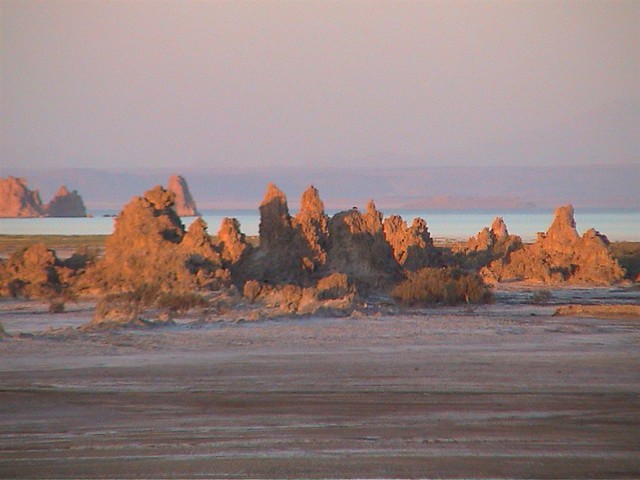
Lake Abbe


Lake Abbe is within the Danakil Depression, the lowest place on earth and one of the hottest. The landscape is wild and volcanic and the Afar who live here are perfectly adapted to their harsh environment. If you want to know what they use their curved knife for 'the jile', you really need to read Thesigers 'The Danakil Diary'.


Image result for danakil depression
Volcanic activity in the depression