Showing posts with label Genghis Khan. Show all posts

Saturday, 4 May 2013

Bukhara & Genghis Khan- Uzbekistan

Whilst Kyrgyzstan is without doubt my favourite country in Central Asia, Bukhara in Uzbekistan remains my favourite city.

Bukhara has seen it all. Alexander the Great passed this way. When the Horde ransacked the city, Genghis Khan marvelled at the Kalyan minaret, before using it to fling his victims to their deaths.  When survivors eventually returned to the remains of their city they renamed it the Tower of Death.  


Kaylan Minaret
The extremely bad tempered 19th Century Emir- Nasrulla, favoured lingering deaths for his victims in a bug infested pit, including two unfortunate British Officers which he eventually beheaded. He finally fled the advancing Russians to Tajikistan, leaving a trail of dancing boys in his wake as an unsuccessful diversion.

Bukhara had the greatest collection of madrasas in Central Asia before the communists arrived and left them to fade away. 

It was also a disease infested place with many of the inhabitants suffering from guinea worm known locally as Bukhara boil, contracted from the pools of water built in this desert oasis for people to wash, bathe and drink from. One of the first actions of the Russian regime was to fill these pools in, and to construct alternative water supplies, leaving only the marvellous pool of Layb-I- Khauz and its chai khanas intact.

Taking tea at the pool of Layb-I-Khauz

The Ark was the Citadel of the Emir and it was in front of these gates that the bodies of Stoddart and Conolly the two British Officers were buried.

The Ark

Walking through Bukhara is history brought to life. Bukhara Burnes may have travelled this way only a week or two before instead of 186 years ago. For over 2000 years Bukhara has played a key role in the region, from stop overs on the Silk Road to the Great Game.

Sunday, 17 March 2013

Uzbekistan - Bukhara & Samarkand

This is that place most people with an inkling of Central Asia are thinking of.

The silk route cities of Samarkand, Bukhara and Khiva. Alexander the Great's Ă“xus river  and the Aral Sea.
Russian anthropologist Mikhail Gerasimov ignored the legend that disaster would befall anyone who disturbed the tomb of Timur the Lame ( Tamerlane ) in the Registan of Samarkand. The day was 22nd June 1941 and within minutes  news was heard Germany had invaded Russia. Two years later within weeks of being reburied the Germans surrendered at Stalingrad.

For the Great Game, the British Officers Stoddart and Conolly were thrown into a verminous pit by the Emir of Bukhara and eventually beheaded outside of  the Ark or Citadel. The pit is still there.

The Metro in Tashkent, built after the great earthquake of 1966 is a work of art in itself and the Opera house build by prisoners of war … the sense of history is everywhere.

Samarkand is now an industrial town but to visit the Registan is one of life's great experiences as are  the remains of  Ulug Bek's observatory high above  the town. His observations placed him in the same league as Copernicus. Like Galileo he eventually fell foul of religious orthodoxy and the observatory was torn down by religious fanatics. Its re discovery in 1909 is considered one of the major discoveries of the 20th Century.


The Registan, Samarkand.


Bukhara remains my favourite in Uzbekistan. It's a magical place. The Ark and the timeless pool of Lyab-i-Khauz . The Kaylan minaret was spared from destruction by Genghis Khan, who found it a convenient height from which to fling the vanquished to their deaths. Thereafter it became known as the Tower of Death.
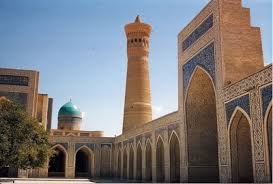

The Kaylan minaret

I was fortunate to travel across Uzbekistan in the early 1990's as an old world order was evaporating, and a new direction for the County had yet to be determined.